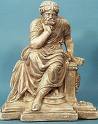
Webquest 1 Socrates
INTRODUCTION TASK PROCEDURES EVALUATION
Socrates was a very important philosopher in our history. He was born in Athens in ancient Greece. He got in trouble with the law because he had different ideas than the majority of the people in his time.
You are a member of the tribunal who must judge Socrates. You must analyze carefully the arguments that Socrates gives you to convince you of his innocence.
Task 1. At the end of this webquest you must have a powerpoint with images and the principal arguments that Socrates gave to the tribunal for his defense. This powerpoint must have a minimum of 10 slides.
Task 2. You must also write a little text where you explain your considerations about his innocence or guilt.
Task 3. You might be selected to do an oral exposition of your research.
A.- You must look for the principle of the Socrate´s philosophy:
http://en.wikipedia.org/wiki/Socrates
http://www.spaceandmotion.com/Philosophy-Socrates-Philosopher.htm
B.- The judge of Socrates:
http://www.age-of-the-sage.org/greek/philosopher/trial_death_socrates.html
http://classics.mit.edu/Plato/apology.html
ASSESSMENT
|
GOD
|
Philosopher
|
CITIZEN
|
Unaware-Ignorant
|
CONTENT:
|
Find at least 10 pieces of information. |
Find at least 8 pieces of information. |
Find at least 6 pieces of information. |
Find at least 4 or less pieces of information. |
Summary content: Putting it all together |
• All information accurate.
|
• Most information accurate.
|
• Some information accurate.
|
• Not enough accurate information.
|
Oral presentation |
• All creative and original.
|
• Mostly creative and original.
|
• Sometimes creative and original.
|
• Not enough creativity and originality.
|
Congratulations on successfully finishing your research. I hope you know more about the philosophy and life of this important Greek. Also, you can now understand the difficulties you can find if you have different ideas in a society and you want to defend them in spite of being considered a stranger or dangerous person by the majority of people. But in Socrate´s case, he was not a stranger, he was extraordinary.